Screening
What Is Screening
What is “screening”? A screening is a brief look at a child’s skills in certain areas. This is accomplished through looking at how the child performs on specifically chosen activities that will bring out certain skills for the therapists to observe. The activities chosen for the screening are activities the child would typically do through their day at home and daycare/preschool.

The child plays one-to-one or in small groups with an occupational therapist, physiotherapist and speech-language pathologist. At times, activities and observations may be done in the classroom setting. Examples of activities include, completing a craft, stringing beads, looking at and talking about what is happening in the book, playing listening games, running, jumping and kicking/throwing a ball.
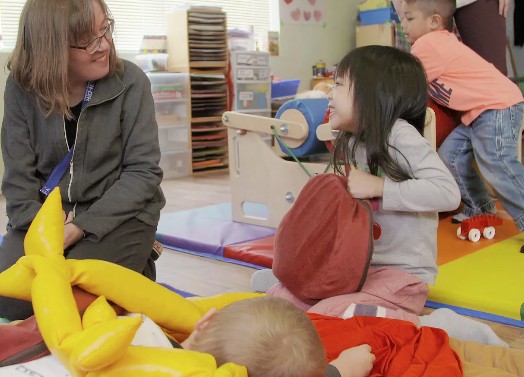

The child plays one-to-one or in small groups with an occupational therapist, physiotherapist and speech-language pathologist. At times, activities and observations may be done in the classroom setting. Examples of activities include, completing a craft, stringing beads, looking at and talking about what is happening in the book, playing listening games, running, jumping and kicking/throwing a ball.
Please note: Children who are between the ages of 2 years 8 months and 3 years 7 months by September 1, 2024, will be seen by SLP only, unless other areas are identified as a concern. Using these types of activities, the therapists are able to observe the child’s skills that are expected for their age.
Examples of skills include, how the child is able to listen and follow directions, how they use their hands with small tasks (e.g., hold a crayon, using scissors, placing beads on a string), how well they are understood when speaking, ball skills, balance in and not in motion, how they play with other adults and children.

Steps For The Process:

1. SCREENING
A screening is conducted to identify potential areas of weakness or concern within specific developmental areas. If the screening identifies a concern that may require further evaluation, a formal assessment is recommended. If no significant concerns are identified, a formal assessment may not be necessary at that time.
2. FORMAL ASSESSMENT
A formal assessment is conducted to identify the level of need in specific areas. If the assessment identifies an area that requires support or intervention, appropriate therapy sessions may be recommended. If no significant concerns or needs are identified in a particular area, therapy sessions may not be necessary at that time.
3. EARLY INTERVENTION
The early intervention program is tailored to the individual needs of each child. The type, frequency, and duration of intervention are based on the specific areas of need identified through the formal assessment, with the goal of providing appropriate support to promote the child’s development and progress.